US State Residency for Digital Nomads: 2026 Tax Guide

Anúncios
Establishing US state residency for digital nomads is a critical decision impacting tax obligations, legal rights, and financial planning, requiring careful consideration of domicile rules and state-specific benefits in 2026.
Anúncios
As the digital nomad lifestyle continues its rapid expansion, understanding US state residency for digital nomads has become more complex and crucial than ever. For those earning an income remotely while traversing the country or the globe, the question of ‘where do I legally reside?’ can significantly impact tax liabilities, voting rights, and access to state-specific benefits. This deep dive into 2026 considerations aims to demystify these complexities, offering clarity for the modern remote worker.
Defining Domicile vs. Residency: The Core Distinction
For digital nomads, the terms domicile and residency are often used interchangeably, but they carry distinct legal meanings that profoundly affect tax obligations and legal standing. Understanding this fundamental difference is the first step toward strategic state residency planning.
Anúncios
Domicile refers to your true, fixed, and permanent home, the place to which you intend to return whenever you are absent. It’s about intent and connection, not just physical presence. You can only have one domicile at a time, and changing it requires clear intent and overt actions. Residency, on the other hand, can be established in multiple states simultaneously, often based on physical presence for a certain number of days within a tax year. While you might be a resident of several states for tax purposes, you will only ever have one domicile.
The legal nuances of domicile
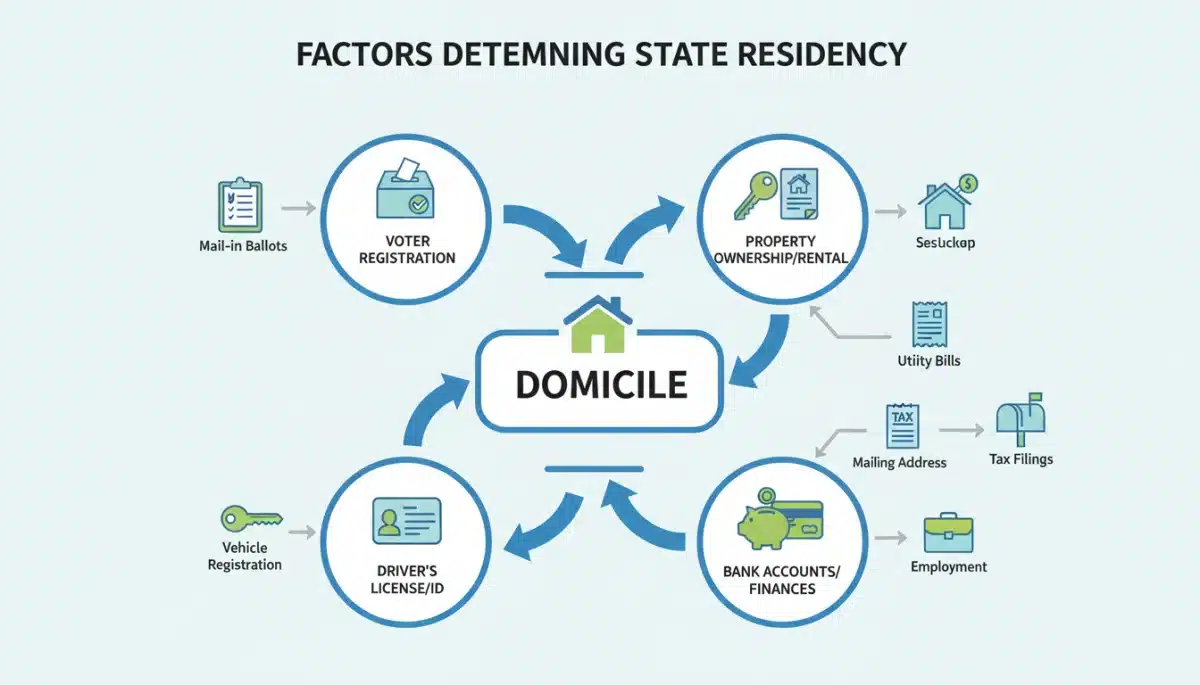
Establishing or changing domicile is not a trivial matter. Courts look at a variety of factors to determine intent, and simply stating a new domicile isn’t enough. It requires a genuine shift in your life’s center of gravity. This is particularly relevant for digital nomads who might spend limited time in any single location.
- Voter registration in the new state.
- Obtaining a driver’s license in the new state.
- Registering vehicles in the new state.
- Opening bank accounts and establishing financial ties in the new state.
- Severing ties with the old state, such as selling property or closing accounts.
These actions collectively demonstrate a clear intent to make a new state your permanent home. Without such demonstrable actions, tax authorities may challenge your declared domicile, leading to potential audits and unexpected tax liabilities.
Ultimately, the distinction between domicile and residency is paramount for digital nomads. Your domicile determines where your primary tax obligations lie, while residency can trigger tax duties in other states you spend significant time in. Navigating this landscape requires careful planning and a thorough understanding of each state’s specific rules.
States with Digital Nomad-Friendly Residency Rules
Not all states are created equal when it comes to accommodating the digital nomad lifestyle. Some states have inherently more favorable tax structures or clearer guidelines that make establishing residency less cumbersome. Choosing the right state can significantly impact your financial well-being and administrative overhead.
When considering a state, digital nomads often prioritize those with no state income tax. This immediately reduces the tax burden on their remote earnings. Beyond income tax, factors like sales tax, property tax, and ease of establishing domicile without extensive physical presence are crucial.
Top contenders for digital nomads in 2026
Several states consistently rank high for digital nomads seeking tax efficiency and ease of residency. These states often have clear definitions of what constitutes domicile and fewer hoops to jump through for those not physically present year-round.
- Florida: Known for its lack of state income tax and relatively straightforward process for establishing domicile. Many digital nomads use a physical address, such as a mail forwarding service, and take steps like obtaining a Florida driver’s license and registering to vote.
- Texas: Another state with no state income tax, Texas offers similar advantages to Florida. Establishing domicile involves demonstrating intent through similar actions, making it an attractive option for many.
- Nevada: With no state income tax, Nevada is also a strong candidate. Its residency requirements are generally clear, appealing to those seeking tax benefits.
- South Dakota: Often favored by RVers and full-time travelers, South Dakota has no state income tax and highly accommodating residency rules. Many use mail forwarding services and can establish residency with minimal physical presence, typically a single overnight stay at a hotel or campground.
- Wyoming: Similar to South Dakota, Wyoming offers no state income tax and favorable residency laws, often used by those who value privacy and minimal bureaucratic hurdles.
While these states offer significant advantages, it’s essential to understand that simply choosing one of them isn’t enough. You must actively take steps to establish domicile and sever ties with previous states to avoid dual residency claims and potential tax issues. Each state has specific criteria that must be met, and these can evolve.
Tax Implications for Digital Nomads: Income, Sales, and Beyond
The primary driver for many digital nomads to carefully consider their state residency is taxation. Beyond federal taxes, state taxes can significantly impact your net income. Understanding the various types of state taxes and how they apply to your mobile lifestyle is critical for financial planning.
State income tax is often the most significant concern. As mentioned, some states have no income tax, offering substantial savings. However, even if you establish domicile in a no-income-tax state, you might still incur income tax liabilities in other states where you physically perform work or generate income, depending on their nexus rules.
Navigating multi-state tax liabilities
The concept of ‘nexus’ is crucial for digital nomads. Nexus refers to a sufficient physical presence or economic connection to a state that triggers tax obligations. For individuals, this often means spending a certain number of days in a state. Many states have a 183-day rule (half the year), but this can vary widely.
- Income Tax: If you perform work in a state where you are not domiciled, you might be required to pay income tax on the portion of your income earned while physically present there. Some states offer credits for taxes paid to other states to prevent double taxation.
- Sales Tax: While generally less of a direct concern for service-based digital nomads, if you sell physical products, you may need to collect and remit sales tax in states where you have nexus.
- Property Tax: If you own real estate, property taxes will be due to the jurisdiction where the property is located, regardless of your domicile.
- Intangible Personal Property Tax: A few states still levy taxes on certain intangible assets, though this is less common.
It’s also important to consider the ‘convenience of the employer’ rule in some states. If your employer is based in a state with this rule (e.g., New York), you might be taxed by that state even if you work remotely from another state, unless your working from home is for the employer’s necessity, not convenience. This rule can complicate tax planning for digital nomads working for companies in such states.
Careful record-keeping of your travel and work locations is paramount. Tools like mileage trackers or location-aware apps can help document your physical presence in various states, which is invaluable if you ever face an audit. Consulting with a tax professional specializing in multi-state taxation for remote workers is highly recommended to ensure compliance and optimize your tax strategy.
Legal and Administrative Benefits of Strategic Residency
Beyond tax savings, strategically choosing your state residency offers a range of legal and administrative advantages that can enhance the digital nomad lifestyle. These benefits often go overlooked but can significantly improve quality of life and reduce administrative burdens.
Having a clear, established domicile provides a stable legal home base. This can be crucial for legal matters, such as establishing a will, power of attorney, or even for purposes like jury duty (which you would typically only owe to your state of domicile). It simplifies many bureaucratic processes that require a permanent address.
Advantages extending beyond taxes
The benefits of a well-planned state residency extend into several practical areas, offering stability in an otherwise mobile life. These advantages contribute to a more organized and less stressful existence for digital nomads.
- Vehicle Registration and Insurance: Registering your vehicles and obtaining insurance in a state with favorable rates and straightforward processes can lead to significant savings and fewer headaches. States like South Dakota are particularly popular for RVers due to their accommodating vehicle laws.
- Healthcare Access and Insurance: While health insurance is largely federal through the Affordable Care Act marketplaces, state residency can influence available plans, subsidies, and access to state-specific healthcare programs. Having a consistent state of residency simplifies enrollment and management of health plans.
- Estate Planning: Establishing a will, trusts, and other estate planning documents is more straightforward when you have a clear state of domicile. State laws govern these matters, and having a defined home state avoids potential jurisdictional conflicts.
- Voting Rights: Maintaining your right to vote in federal and state elections requires establishing residency somewhere. For many, this is a civic duty they wish to uphold, and a clear domicile ensures this right.
- Business Registration: If you operate a business as a digital nomad, registering your LLC or corporation in a state with favorable business laws (e.g., Delaware, Wyoming, Nevada) while maintaining your personal domicile elsewhere can offer asset protection and tax advantages.
These administrative benefits highlight that choosing a state of residency is not merely about avoiding taxes. It’s about building a stable legal and administrative foundation that supports the freedom and flexibility of the digital nomad lifestyle, minimizing potential disruptions and maximizing peace of mind.
The 2026 Landscape: What’s New and What to Watch For
The legal and tax landscape for digital nomads is not static; it evolves with changes in legislation, court rulings, and technological advancements. Staying informed about the 2026 outlook is crucial for maintaining compliance and optimizing your residency strategy.
One primary area of focus for 2026 is the ongoing debate around remote work taxation. As more businesses adopt permanent remote work policies, states are increasingly looking at ways to capture tax revenue from individuals working remotely within their borders, even if their employer is located elsewhere.
Emerging trends and potential challenges
Several trends and potential legislative changes could impact digital nomads in the coming years. Being aware of these can help you proactively adjust your strategy.
- Increased State Scrutiny: States are becoming more sophisticated in tracking individuals’ movements and work locations. Data from digital footprints (e.g., phone location data, credit card transactions) could be used to challenge declared residency or claim tax nexus.
- Remote Work Specific Legislation: Some states might introduce new tax laws specifically targeting remote workers, defining nexus more broadly or establishing clearer rules for income apportionment.
- Interstate Tax Agreements: While complex, there could be increased efforts towards interstate agreements or uniform laws to simplify multi-state taxation for remote workers, potentially reducing compliance burdens but also closing loopholes.
- Digital Nomad Visas and Programs: While more common internationally, some US states or cities might introduce incentives or programs to attract digital nomads, potentially offering tax breaks or simplified residency processes.
- Evolving Domicile Definitions: Courts may continue to refine what constitutes ‘intent’ for domicile, especially for those with no fixed physical address, making clear documentation of intent even more critical.
For digital nomads, the key takeaway is the need for vigilance and adaptability. What works today might need adjustment tomorrow. Regularly reviewing your residency strategy with a qualified professional, staying informed about tax law changes, and meticulous record-keeping will be more important than ever in 2026 and beyond. The trend points towards greater clarity and, potentially, greater enforcement in the realm of multi-state taxation for mobile professionals.
Practical Steps to Establish or Change Your State Residency
Once you’ve decided on your preferred state of domicile, the next crucial step is to take concrete actions to formally establish your residency there and, equally important, to sever ties with your previous state. This process requires deliberate effort and documentation.
It’s not enough to simply declare a new state as your home; you must demonstrate a clear intent to make it your permanent abode through a series of official and personal actions. The more evidence you accumulate, the stronger your claim will be if ever challenged by tax authorities.
A checklist for establishing new domicile
To successfully establish your new state residency, follow a systematic approach. Consistency across all your official documents and personal behaviors is key.
- Obtain a New Driver’s License: This is often considered one of the strongest indicators of intent. Do this as soon as possible after deciding on your new state.
- Register to Vote: Registering to vote in your new state and, if applicable, canceling your registration in your old state, provides further evidence of domicile.
- Register Your Vehicles: Transfer vehicle titles and registrations to your new state. This often goes hand-in-hand with obtaining a new driver’s license.
- Update Financial Accounts: Change your mailing address for bank accounts, credit cards, and investment accounts to your new state. Consider opening new accounts in local banks.
- Change Mailing Address: Set up mail forwarding from your old address to your new one (or a reliable mail forwarding service in your new state).
- Update Estate Planning Documents: Review and update your will, trusts, and power of attorney to reflect your new state’s laws and your new domicile.
- Sever Ties with Old State: Close bank accounts in your old state, sell property, cancel club memberships, and generally minimize your presence and ties there.
- Establish Ties in New State: Join local clubs, establish doctor-patient relationships, and engage in community activities to further demonstrate your connection.
Keep meticulous records of all these actions, including dates and official documents. This documentation will be invaluable if you ever need to prove your domicile. Remember, the goal is to create a clear, undeniable paper trail that demonstrates your genuine intent to make the new state your permanent home, leaving no doubt for any reviewing authority.
| Key Aspect | Brief Description |
|---|---|
| Domicile vs. Residency | Domicile is your permanent home (one only); residency is physical presence (can be multiple states). |
| Tax-Friendly States | States like FL, TX, NV, SD, WY offer no state income tax and favorable residency rules. |
| Multi-State Tax Nexus | Physical presence (e.g., 183 days) in a state can trigger income tax obligations there, even if not domiciled. |
| Establishing Domicile | Requires clear intent and actions: new DL, voter registration, vehicle registration, updating addresses. |
Frequently Asked Questions About Digital Nomad Residency
No, all US citizens and permanent residents must have a legal state of domicile. While digital nomads may travel extensively, they must maintain a primary legal residence for tax, voting, and other legal purposes. Establishing a domicile is a fundamental requirement for legal standing in the US.
The 183-day rule (or similar thresholds) means if you spend more than half the year physically present in a state where you are not domiciled, that state may consider you a statutory resident and tax your income. Digital nomads must track their days to avoid unintended tax liabilities.
While a mail forwarding service is a crucial component, it is generally not enough on its own to establish domicile. It must be combined with other overt actions like obtaining a driver’s license, registering to vote, registering vehicles, and severing ties with your previous state to demonstrate true intent.
The risks include being audited by multiple states, owing back taxes, penalties, and interest to more than one state, and facing legal challenges regarding voting rights, vehicle registration, and other official matters. Dual residency claims can be complex and costly to resolve.
Absolutely. The complexities of state residency, domicile, and multi-state taxation for digital nomads are significant. A tax professional specializing in multi-state taxation can provide tailored advice, ensure compliance, and help optimize your tax strategy to avoid costly mistakes and maximize benefits.
Conclusion
Navigating US state residency as a digital nomad in 2026 is a journey that requires foresight, meticulous planning, and ongoing attention. The decision of where to establish your domicile extends far beyond a simple mailing address; it underpins your tax obligations, legal rights, and administrative ease. By understanding the critical distinction between domicile and residency, strategically choosing a tax-friendly state, and diligently taking the necessary steps to establish and maintain your chosen residency, digital nomads can unlock significant financial and lifestyle benefits. As the landscape continues to evolve, staying informed and seeking expert advice will remain paramount to thriving in the mobile work revolution. Your digital journey begins here with us, and understanding these residency nuances is a vital step in that journey.
